Email is the one marketing channel you own outright. No algorithm decides who sees your message, no platform can raise the price of reaching your own customers, and the list you build this year still belongs to you in five.
The workhorses of email marketing are not newsletters. They are flows: automated sequences that trigger from customer behavior and run forever once built. These are the three to build first.
Flow 1: The welcome series
Triggers when: someone joins your list, usually via a signup form or a first purchase.
The welcome email is the highest-open-rate message you will ever send. Someone just raised their hand; they are paying more attention right now than they ever will again.
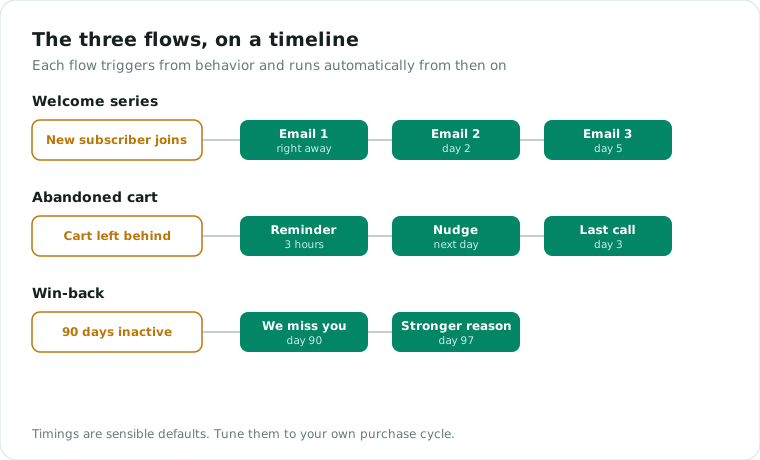
A simple three-email version:
- Immediately: deliver whatever was promised (the discount, the guide), plus one sentence on who you are and what you stand for.
- Two days later: your story or your best content. This is trust-building, not selling.
- Five days later: a gentle push toward the first (or next) purchase, with social proof if you have it.
Service businesses: the same structure works for new enquiries. Deliver the answer, build trust, invite the call.
Flow 2: The abandoned cart
Triggers when: someone adds to cart, or starts an enquiry, and stops.
Roughly seven in ten online carts are abandoned. Most of those people were not saying no. They got distracted, hit an unexpected cost, or planned to come back and forgot. A reminder recovers a meaningful slice of them, and it is the single highest-return automation in e-commerce.
Keep it to two or three emails: a simple reminder within a few hours, a nudge the next day addressing the common hesitation (shipping cost, returns policy, sizing), and optionally a final incentive. Do not lead with a discount, or you train people to abandon carts on purpose.
Service businesses: the equivalent is the unfinished contact form or the unanswered quote. A polite follow-up two days later routinely revives conversations that would otherwise die.
Flow 3: The win-back
Triggers when: a customer has not purchased or engaged in a while. Ninety days is a common starting point; set it to your natural purchase cycle.
Winning back a lapsed customer is far cheaper than acquiring a new one. They already know you, already trusted you once, and often lapsed for no reason at all.
Two emails usually suffice: a “we noticed, here is what is new” message, and a stronger reason to return a week later. Whoever ignores both gets moved to a low-frequency list. Sending less to disengaged contacts protects your deliverability for everyone else.
Why flows come before newsletters
A newsletter is work every single week. A flow is work once, then it runs. Build the automations first, let them produce, and add the newsletter when there is capacity to sustain it. A small list with good flows reliably outearns a big list that only gets broadcasts.
Want the flows without building them yourself? Start with a free audit and we will map which automations fit your business and what they are likely worth.